
Built, Then Forgotten
The O&M Crisis in Indian Cities


Have you ever come across an empty plot and seen construction debris dumped there? Have you thought twice about going to a public park with your children, which was good once but now has broken swings and wild vegetation growing in it? Have you seen dysfunctional dustbins, broken benches, fallen trees, or numerous potholes? Of course you have. This infrastructure is now so much a part of the Indian urban aesthetic that we rarely consider it anymore.
I recently became a parent and have started equating operations and maintenance to the dual role I play as a homemaker and caregiver to my child. It is often taken for granted when done well and goes naturally unnoticed, but when not done, members of the household cannot carry out even simple day-to-day tasks. Operations and maintenance (O&M) is one of the most important aspects of infrastructural development, a sector in itself that has not received its due recognition in policy, much like a homemaker’s role in building the household.
O&M is, by and large, a subject taken care of by urban local bodies in cities. In one of my workplaces, a senior government official who had previously served as a Municipal Commissioner of a few cities had lamented, “it’s a very inhuman job—sadak, naali, kachra—that is what we do, always on call whenever anybody needs help in these matters.” ULBs are responsible for the housekeeping role—ensuring that road repairs happen, drainage and sewerage pipes are mended on time, water supply and metering are provided, and dumped and household garbage is picked up. Nearly all essential services are carried out by municipal corporations and councils, while big-budget projects are, in most cases, executed by state governments, parastatal bodies, and development authorities, funded through state and centrally sponsored schemes. In such a scenario, the burden of maintaining infrastructure built by other institutions lies with the municipal corporation, even though the contracting may not have been done by them in the first place. Urban local bodies, even today, lack the resources, both human and monetary, to operate and maintain their own infrastructure.
A snapshot of Municipal Finances
One of the major sources of revenue for cities is property tax; as per a study by NIUA and Munify, nearly 41% of revenue is generated from this source. The same study shows that, on average, 41% of total revenue is spent on establishment expenditure, which includes staff salaries and administrative expenses. Most municipal corporations are struggling to meet their revenue expenditure through their own sources, and urban local bodies across India are operating with revenue deficits, low utilisation of capital receipts, and low capital expenditure. These are organisational issues resulting from gaps in the implementation of the 74th Constitutional Amendment Act, 1992, which I will be reflecting upon in my forthcoming articles under this series titled Nagar Niti.
A study by the Indian Institute for Human Settlements covering 33 cities across all tiers showed that in 2021–22, 45% of total expenditure was on administrative or establishment expenses, while 36% was spent on O&M. Around 41% of total revenue in the same year was composed of revenue grants. ULBs are heavily dependent on inter-governmental transfers and sources that are not directly leveraged by the ULBs themselves. Inter-governmental transfers include funds received from central and centrally sponsored schemes such as the Smart Cities Mission and the Atal Mission for Rejuvenation and Urban Transformation (AMRUT), which are implemented by the central government to provide basic amenities and public infrastructure in cities, often through Special Purpose Vehicles that are not part of the ULBs. These projects are then handed over to the ULBs for operations and maintenance.
ULBs, Capital Expenditure and the O&M Gap
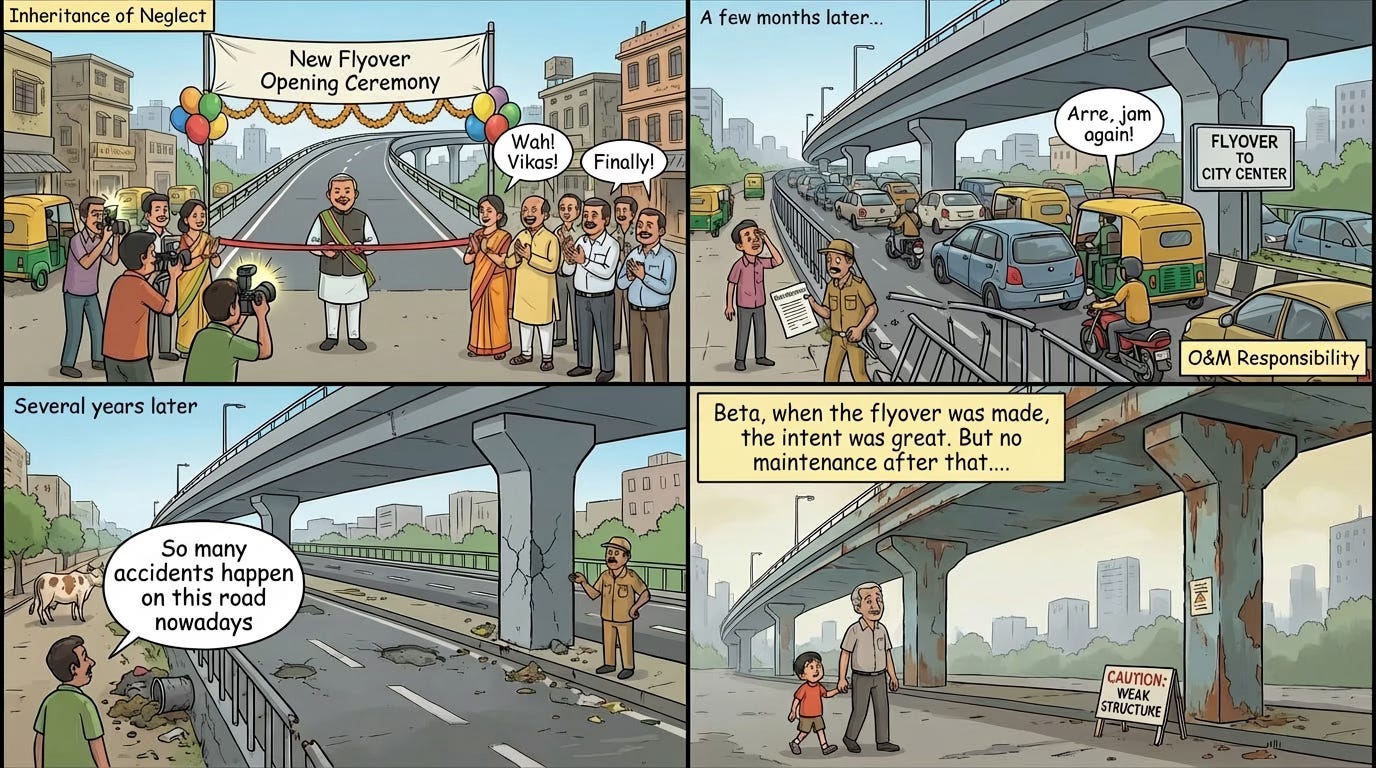
Most ULBs have little or no capacity to fund and execute big-budget projects, which reduces their role largely to operations and maintenance (O&M) of these assets. Big-budget projects such as highways, flyovers, metros, and riverfronts are funded through centrally sponsored schemes or by state-level departments such as Public Works Departments, Development Authorities, and Corporations (for example, DMRC). Many of these projects are also executed under Build–Operate–Transfer (BOT) agreements, where O&M is carried out by the contractor themselves. ULBs are therefore left primarily with the responsibility of providing basic amenities and undertaking O&M of public infrastructure.
Inter-governmental transfers include both tied and untied funds, most of which are meant only for capital expenditure. Even Finance Commission grants, which are intended to provide funds to cities through state governments, are largely restricted to capital expenditure and do not have a clearly allocated O&M component. A majority of tied funds are routed through national- or state-level schemes, where project costs are typically shared in a 60–40 or 70–30 ratio, with the Centre and State contributing the larger share and municipal corporations funding the remaining portion from their own-source revenues. For many cities, own-source revenue is already limited in comparison to the 30–40% share they are required to contribute.
What is more critical, however, is the proportion of the project budget that is actually spent on operations and maintenance. Surprisingly, none of the central or state schemes mandate a fixed percentage of project costs to be allocated to O&M. While it is mandatory for ULBs to plan and cost O&M when proposing projects under these schemes, neither the percentage of project cost is prescribed nor is there adequate monitoring and evaluation to ensure that O&M is carried out post-implementation. It is also important to note that a significant share of funds under programmes such as Smart Cities, AMRUT, and Finance Commission grants is utilised for the provision of basic amenities and the creation of public spaces, including projects such as riverfronts. These projects are then handed over to the ULBs for O&M.
O&M: An Afterthought?
There are crores of rupees spent on city infrastructure projects, and yet, within a year, we see the quality of infrastructure deteriorate. This results from the massive gap in O&M planning and funding. The capacity for O&M is rarely considered while planning and executing projects in urban areas. While the ULB is a party to deciding the projects to be implemented in its city, it is not involved in deciding the quality of materials used in building the infrastructure, nor is it held accountable for mandatorily executing its O&M plan effectively.
During a few of my field visits while interviewing city councillors, I encountered many of them telling me how day-to-day work often needs to be done from their own pockets, as there is no proper fund allocated to them to administratively retrieve the money. They had requested that a budget be allocated to their ward, to be spent at their discretion, so that they can actually look after road repairs, sewerage line repairs, and solid waste management effectively within their own ward.
To conclude, but not yet
Urban policies require a re-visit on this matter; such a crucial aspect of infrastructure deserves far more attention and redressal than it currently receives. Poor O&M affects everybody’s life; however, infrastructure, if not maintained, pushes certain groups to the margins, becoming a disabler as opposed to its original function. Yet, O&M should be one of the central aspects discussed, planned, and executed, without which no project ought to move forward. It cannot remain a token report prepared merely to access funds, but must be actively monitored and seen through by apex government bodies and citizens alike.
It is important to note that many soft infrastructural aspects also need to be part of project execution: stakeholder engagements, awareness campaigns, and design elements that influence user behaviour, all of which take into account the beneficiaries who share civic responsibility for maintaining public infrastructure built for them. All of these require engagement of the local government, and changes need to be made in their day-to-day activities. Without strong policy backing, however, this is going to be messy. We require clear ground rules, provisions, and decision-making rights for O&M across the policy pipeline to make a difference and change attitudes towards it. Big-budget projects are crucial for a nation’s growth and development, but global best practices would not exist if they had not been operated and maintained well for decades. While we, as citizens, often question governments on policies and budgets, proportionate research and discourse on operations and maintenance and the challenges it faces remain largely missing.
The more I researched and wrote about this topic, the more I realised that this deserves more than a single article. The O&M crisis is much larger, not limited to fund allocation and monetary gaps alone. Policy gaps exist right from the planning stage to implementation, spanning constitutional provisions, decentralisation, and the distribution of functions and powers, all of which influence budgetary decisions. In my subsequent articles, I will explore these issues in greater depth and reflect on the enforcement mechanisms and citizen engagement required to address them. I will be unpacking these layers in the coming pieces—so stay tuned to Nagar Niti—as this is a subject that warrants far more attention than it currently receives.